

Siemens Gas & Energy circular saw housing

The challenge
Siemens Gas & Power keeps thousands of homes and businesses running. The Gas & Power Division - one of three Siemens companies - has compressors, turbines and generators worldwide. When a gas turbine housing needs to be repaired, Siemens engineers have to work very precisely with a circular saw. As the housings have very complex contours, a standard circular saw is not sufficient. In the past, the team has remedied this by purchasing standard circular saws and sending them to contract machining stores in the Philippines to create panels with custom contours and then sending them back to the U.S. for reassembly. This was not an efficient solution as engineers had to wait more than 3 weeks for their custom hand tools.
Request a DEMO component now!
See for yourself how strong the continuous fibers are.
The solution
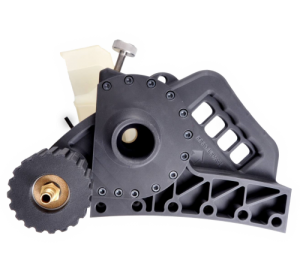
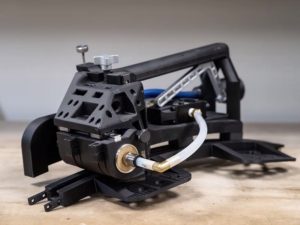
Siemens engineers realized that most of the circular saw components could be printed to exactly match the contour of the turbine. The team felt the Markforged X7 3D printer was the best choice and purchased it. "We bought a standard motor and the blade, but everything else was custom made," said Siemens Gas and Power Engineer Sam Dicpetris. The parts were first tested in Onyx - a nylon base with carbon short fibers - and then reinforced with a continuous carbon fiber to stiffen the structure.
With the 3D printed housing, repairing the turbines on site no longer took weeks, but just a few days. "We can 3D print tools that fit the exact contours of the things we want to make. That's different from anything you can buy off the shelf," says Sam Dicpetris. Siemens Gas & Energy has not only reduced the time it takes to produce these tools from weeks to days, but has also saved money and remains competitive thanks to modern technology. Sam Dicpetris estimates that the team has saved over 8,000 $ with just one customized circular saw housing and hundreds of thousands of dollars with other applications.
After tackling this project, the engineering team began to develop a concept for solving the problem using additive manufacturing. The engineers at Siemens Gas & Energy are now first determining whether manufacturing with the 3D printer makes sense before considering the traditionally manufactured components.
The future
More than 100 engineers at Siemens Gas & Energy are now using Markforged technology and driving developments using additive manufacturing. These engineers are constantly exploring new applications - for example, modular fasteners for turbine blades - to improve their product line and workflow. Their printers are in operation almost around the clock, with little or no downtime. The company also uses the Metal X to produce individual metal parts. The external machine builder also has a Metal X in-house to meet the company's need for fast metal components. Next 47 (the venture arm of Siemens) believes in Markforged's technology and the people behind it and has invested in the company as it continues to grow.
"The strength of the continuous carbon fiber is really impressive. When you have a plastic part that looks and feels like a plastic part, but it has this tremendous strength, everyone is amazed!"
- Sam Dicpetris, Engineer, Siemens Gas & Energy
Learn more about 3D printing with continuous fibers!
Which continuous filament is suitable for which application? How do I design correctly for filament 3D printing? What do users say about it, and where can I find more information? – You've come to the right place! We've listed several information sources that will help you get the answers you need.
Composite Design Guide
DfAM – How to best design your component for 3D printing with composites? This guide provides valuable tips on design and material selection.
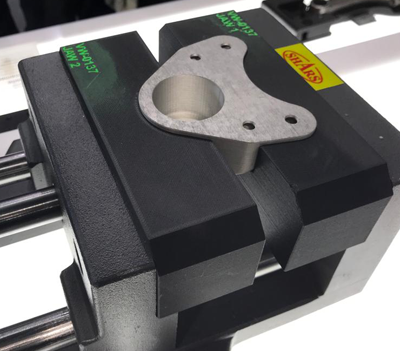
3D printing in manufacturing
In this guide, we explore the diverse applications for 3D printing in industrial manufacturing. How can you identify a good application?
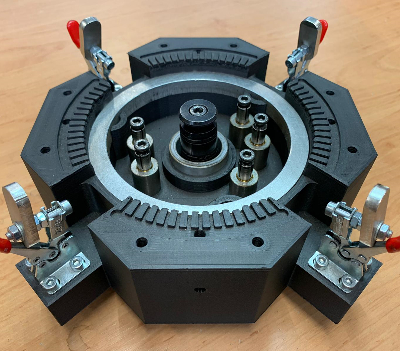
Primetall user report
In this practical application report from Primetall, custom fixtures were printed using 3D printing. It was practically "drilling around corners."
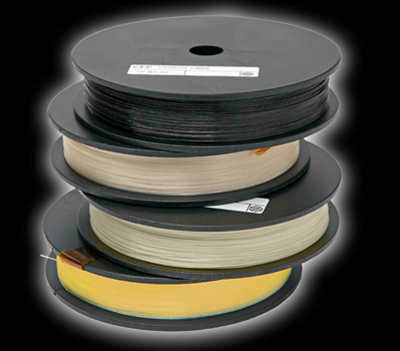
Webinar Composite Fiber 3D Printing
Find out which material works for which application and how you can individually insert it into the component with EIGER.