

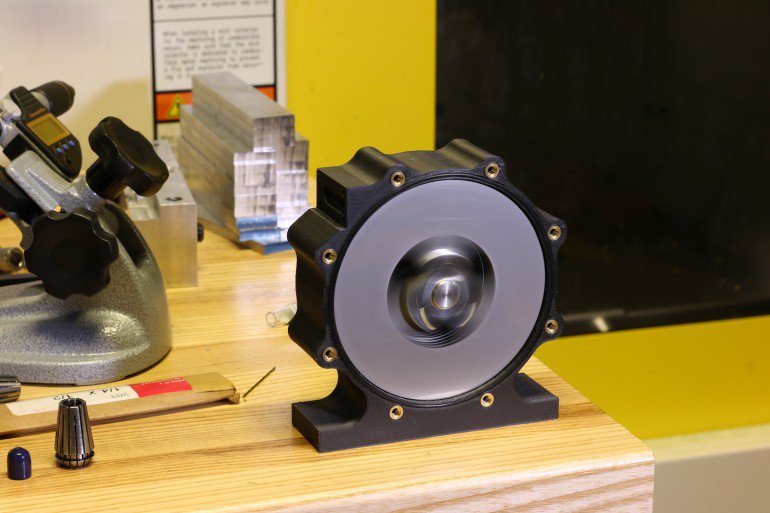
Welcome to a two-part series on retrofitting a Tesla turbine with Marktforged parts. We'll design and print using previously explained techniques to ultimately create a functioning, fast-rotating Tesla turbine. The first part covers the basics and printing of the turbine housing.
What is a Tesla turbine?
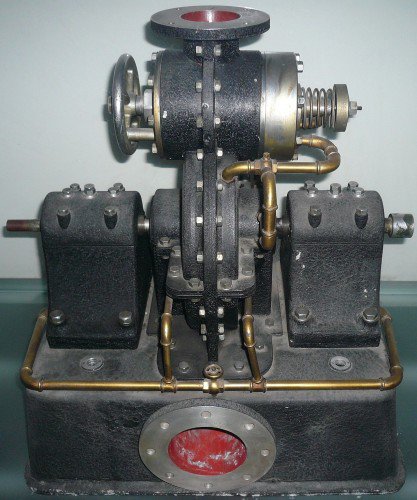
A Tesla turbine is a bladeless centripetal flow turbine patented by Nikola Tesla in the early 20th century. Just like turbines with blades, it converts flows into
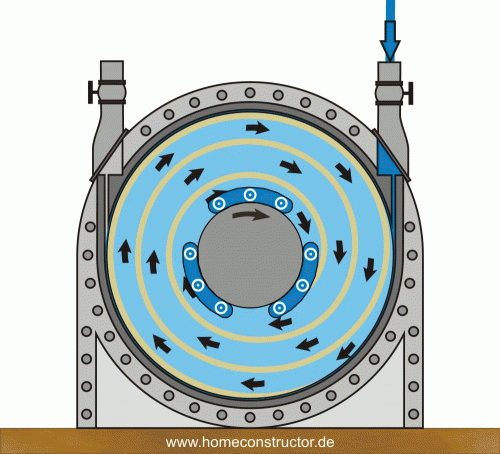
Energy is converted, but driven by smooth, parallel disks. Fluids enter the turbine tangentially to the disk at the outer edge, causing rotation due to their viscosity and surface adhesion. Losing speed and energy, they spiral toward the turbine center, where they exit through the exhaust port. The following image shows the flow motion and energy transfer in a Tesla turbine.
Nikola Tesla initially described his Tesla Turbine as his “most important” invention, saying it could maintain efficiency and increase energy production with its simple construction.
revolutionize. In fact, its two competitors at the time – the piston engine and the blade turbine – were expensive, complicated, and often in need of repair. Practical experience produced sobering results. In reality, the efficiency was only 40%. While this was still higher than that of blade turbines (25-30%,) the disks of the Tesla turbine deformed drastically at their high speeds, rendering them unusable. Today, only small Tesla turbines are built for teaching purposes. Although the turbines failed to live up to expectations, they are still fascinating machines.
Rebuilding a turbine with 3D-printed parts
For this project, we used Olin College Machine Shop's design of a Tesla turbine with three core systems: shaft and rotor, a bearing housing, and a turbine housing. Shaft and
The rotor is clamped into the bearing housing and enclosed by the turbine housing. The bearing and turbine housing fit together with a locking feature and eight screws.
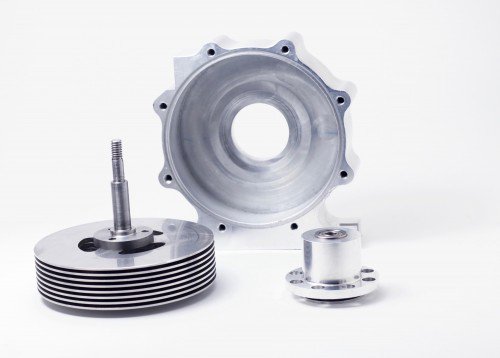
It makes sense to turn the required parts. All you need is a 2-axis CNC machine.
The following is a parts list of the turned parts in the turbine.
Turbine housing: CNC-machined aluminum
Stock version: turned and CNC-milled aluminum
Wave: turned steel
spacers: water jet cut steel
wing: water jet cut and turned steel
Clamp support plate: CNC-machined aluminum
disc: turned aluminum
Inflow block: CNC-machined aluminum
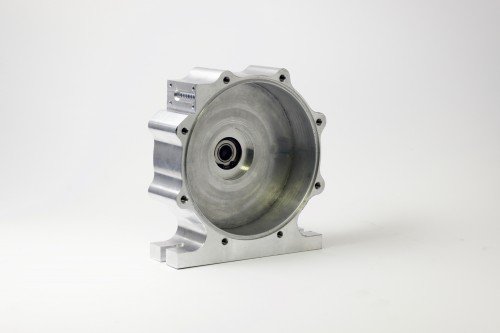
Additive manufacturing isn't suitable for some turbine parts. We'll focus on those that can be printed: the turbine housing and the bearing housing (the latter in part two). Using 3D printing, we can drastically reduce the weight of the turbine housing while maintaining its strength.
Requirements for the turbine housing
The turbine housing must fit perfectly with the bearing housing to prevent vibrations that could tear the turbine apart, even at high speeds. It also requires 16 threaded holes: eight for the bearing housing and eight for the cover plate. The clearance fit between the turbine housing and the blades must be very small to maintain the high efficiency of the rotating blades.
Design and fiber installation
To meet the above requirements, we had to make some changes. Through unit testing, we determined that we needed to reduce the cavity in the CAD program by 0.002" to stay within tolerance. We then replaced all threaded holes with holes for special threaded inserts, which are inserted using heat.
Carbon fibers are used to reinforce the part so it won't deform due to the bearing housing and subsequent forces. Once we loaded it into Eiger, we were ready to print.
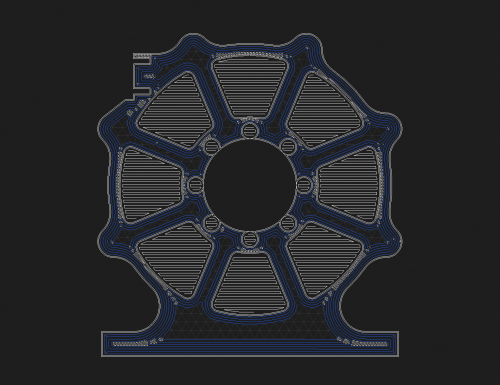
Dimensional testing
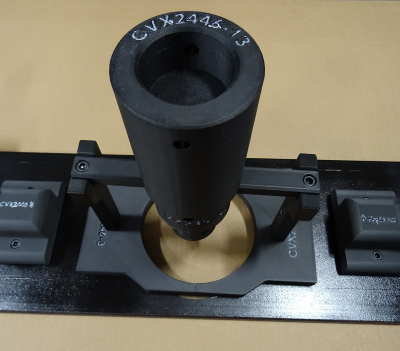
The turbine body fits a Mark Two, but based on the laser dimensional check, we wanted to print it on the Mark X. The unit tests assured us of accurate dimensions. Now we can check the accuracy during printing with two laser scans. One checks the connection feature with the bearing housing, and the other checks the diameter of the cavity.
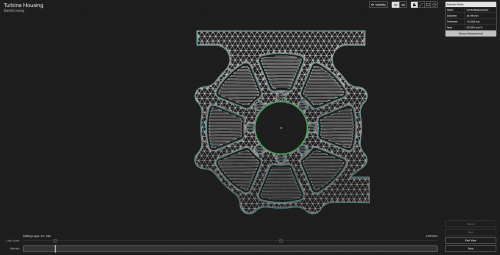
Next Steps
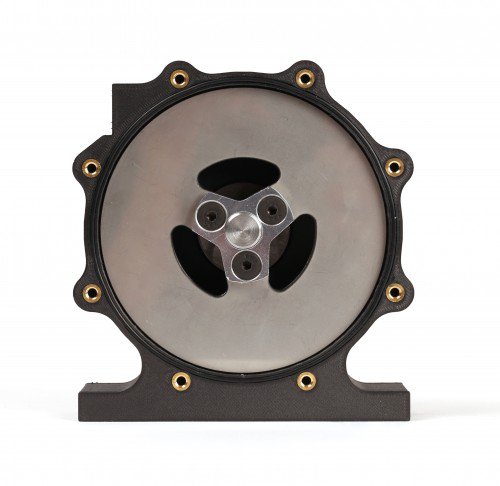
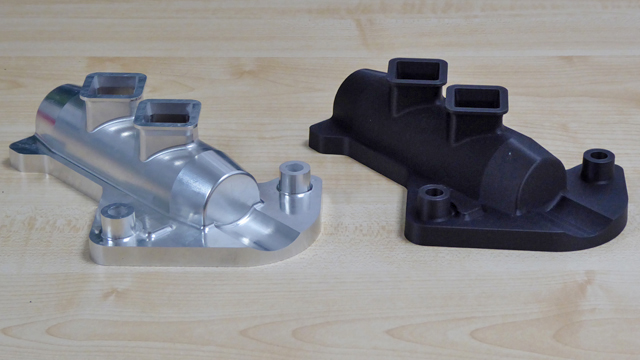
Once the print was complete, we inserted the threaded inserts and attached the aluminum bearing housing. Including the internals, the printed turbine weighed 170 grams, light compared to the 570-gram aluminum housing. After ensuring the metal housing, shaft, and rotor worked, we designed and printed the bearing housing, which we'll cover in the next article in this series.


Looks very interesting, thank you! Are all the turned parts 3D printed? Surely they have to withstand a lot, and metal would make sense in some places, right?