
The Hidden Cost of Missing CAD Data
In-house 3D scanning is becoming a critical capability for manufacturers looking to reduce downtime and regain control of legacy parts. When a component fails and no CAD file exists, production slows, engineers react, and outsourcing delays begin to stack up.
In many manufacturing businesses, the biggest bottleneck isn’t machinery – it’s missing digital data.
A production issue arises. A fixture needs modification. A replacement part is required. And then the problem appears: there’s no accurate 3D model.
The Parts That Don’t Exist – On Paper
Most established manufacturers carry some form of legacy burden. Tooling is modified over time without updated models, components were supplied years ago by vendors who are no longer trading, and manual adjustments have been made on the shop floor without formal documentation.
Fixtures evolve, product lines are acquired, and technical data becomes incomplete.
None of this is unusual. In fact, it’s entirely normal in mature operations.
But when production depends on those parts, and no accurate digital record exists, the issue shifts from historical inconvenience to operational risk. Modern manufacturing runs on data, and when that data is missing, the friction becomes visible across the business.
The Real Cost of Missing Data
The impact of missing CAD data rarely stays contained within a single engineering task. Instead, it ripples across production, engineering resources, and delivery performance.
When a part fails without a digital model, time is immediately lost. Measurement takes longer, reverse engineering becomes a manual process, and outsourcing introduces further delay. Iteration cycles stretch out, and in many cases production slows or stops altogether.
Downtime is not just a labour cost. It affects shipment schedules, customer commitments, and overall production capacity.
At the same time, highly skilled engineers are pulled away from forward-looking work. Instead of focusing on optimisation, automation, or innovation, they are forced into reactive workflows. Manual measurement, trial-and-error modelling, repeated adjustments, and constant verification all consume valuable engineering time.
Many businesses attempt to bridge this gap by relying on external scanning or metrology services. While often necessary, this introduces its own challenges. Scheduling delays, shipping time, additional cost, and reduced control all become part of the process. There are also concerns around confidentiality, along with the risk of rework if the data returned is not quite right.
For organisations already under pressure to reduce lead times, this dependency can become a structural bottleneck. In contrast, in-house 3D scanning restores control and removes these layers of delay.
Why In-House 3D Scanning Matters in Modern Manufacturing
Across the industry, manufacturers are investing in additive manufacturing, simulation tools, digital twins, automated inspection and advanced CAD workflows. All of these depend on accurate digital geometry.
Without reliable 3D data, the ability to optimise parts, improve tooling, validate tolerances or redesign components is restricted.
This means the issue is no longer just about replacing a part, it’s about enabling, or restricting, your broader digital capability.
What Modern Manufacturers Are Doing Differently
Forward-thinking engineering teams are no longer waiting for problems to expose gaps in their data. Instead, they are proactively digitising legacy components and building internal digital part libraries.
They are capturing worn or modified parts before failure occurs, reducing reliance on external services, and creating faster, more predictable reverse engineering workflows.
The shift is subtle but powerful. Instead of reacting to problems, these organisations are building controlled, repeatable digital processes.
The difference is speed.
The difference is control.
The difference is ownership of digital assets.
Bringing 3D Capture to the Shop Floor
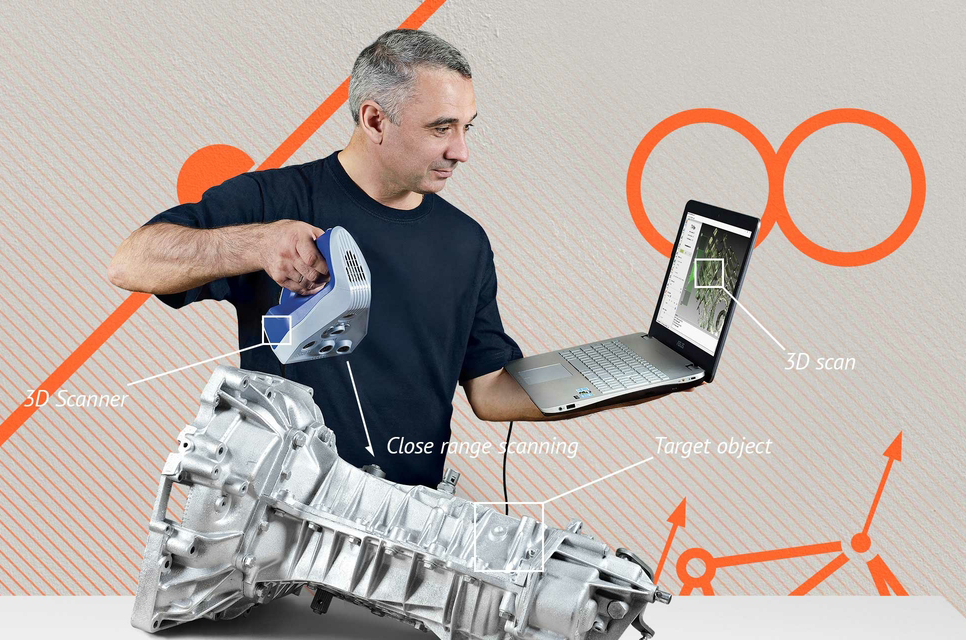
Modern handheld 3D scanning systems now allow engineering teams to capture accurate digital data directly on-site. Whether on the shop floor, in the quality lab, or in R&D, parts can be digitised in minutes rather than days.
This immediacy changes the entire workflow. Reverse engineering can begin straight away, inspection comparisons can be completed faster, and production is no longer forced to wait for external processes.
For many manufacturers, the question is no longer whether in-house 3D scanning is valuable, but whether continuing without it is sustainable.
Closing the Digital Gap
Missing CAD data can feel like a minor inconvenience when operations are running smoothly. But when production stops, its true cost becomes clear.
Manufacturing performance increasingly depends on digital control — and digital control begins with accurate 3D data.
If your team regularly encounters legacy parts, undocumented tooling, or delays in reverse engineering, it may be time to reassess where the real bottleneck lies. In-house 3D scanning is no longer a niche capability for advanced manufacturers. It is becoming a fundamental requirement for maintaining efficiency and competitiveness.
Ready to Take Control of Your Digital Workflow?
If you’d like to explore how in-house 3D scanning could fit into your engineering process, we can review your specific application and assess its suitability.
Bring the part. We’ll show you what’s possible.




Leave A Comment