
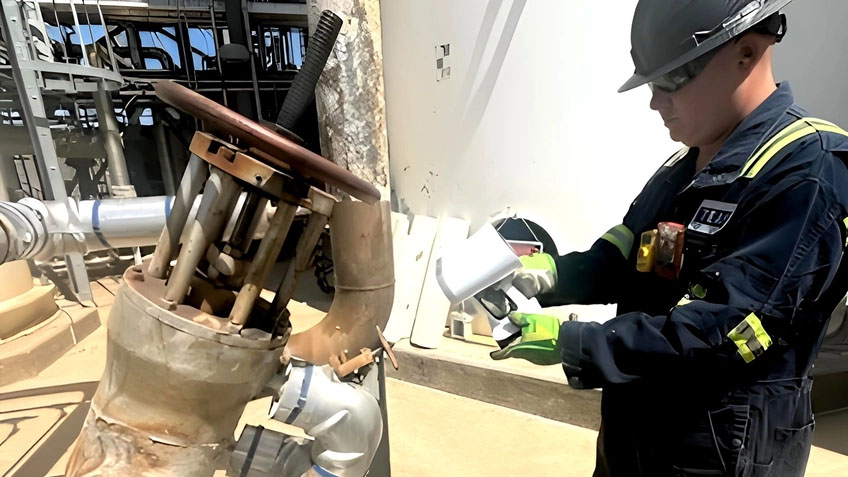
For many manufacturers, one of the biggest barriers to keeping production moving isn’t machining capacity, material availability, or even labour shortages. It’s missing information.
A component fails unexpectedly, but the original CAD model can’t be found. A legacy assembly requires modification, yet the available drawings no longer reflect what is actually installed. A replacement part is urgently needed, but years of undocumented changes mean the physical component bears little resemblance to the original design documentation.
These situations are far more common than many organisations realise. Over time, equipment is modified, repaired, upgraded, and adapted to meet changing operational requirements. Drawings become outdated, CAD files are lost, and institutional knowledge disappears as personnel move on. Eventually, manufacturers find themselves relying on physical parts as the only reliable source of information.
This is where industrial 3D scanning is becoming an increasingly valuable engineering tool.
The Challenge of As-Built Reality
In theory, every manufactured component should be supported by accurate design documentation. In practice, engineering teams regularly encounter situations where that simply isn’t the case.
Legacy machinery may have been installed decades ago. Spare parts may have originated from suppliers that no longer exist. Production tooling may have evolved through countless modifications without those changes ever being formally recorded.
When replacement or refurbishment becomes necessary, engineers are often left with two options: manually measure the component or start from scratch.
For simple parts, manual measurement may be sufficient. However, as geometry becomes more complex, the process quickly becomes time-consuming and increasingly prone to error.
Castings, fabricated assemblies, moulded components, freeform surfaces, and worn production parts can require hours or even days of measurement before meaningful engineering work can begin.
Meanwhile, production waits.
Accelerating Reverse Engineering Workflows
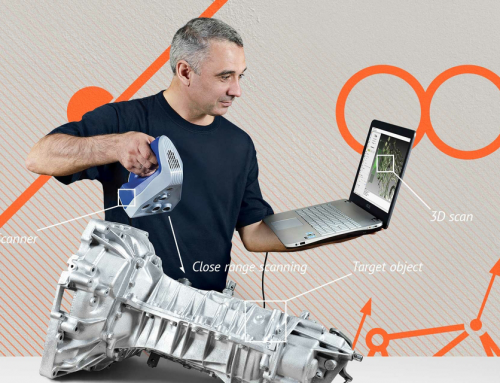
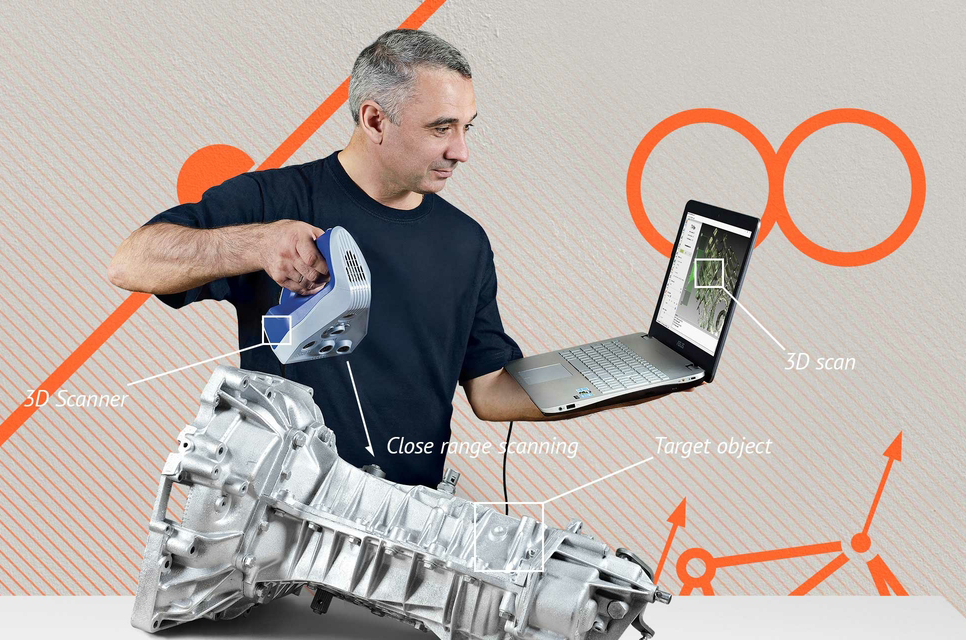
Modern handheld 3D scanners allow engineers to capture complete digital representations of physical parts far more quickly than traditional measurement methods.
Rather than measuring selected features individually, scanners collect millions of data points across the entire surface of a component. The resulting digital model provides an accurate representation of the part as it exists today, rather than how it may have been designed years ago.
This approach significantly reduces the time required to begin reverse engineering projects.
Once scan data has been captured, engineers can create CAD models, generate technical drawings, redesign obsolete components, or prepare parts for additive manufacturing and conventional production processes.
The result is a faster route from physical part to usable engineering data.
Capturing What Actually Exists
One of the greatest advantages of 3D scanning is that it captures reality.
Traditional drawings often represent design intent. However, manufactured components frequently differ from those original designs due to production variation, wear, repair work, or modifications made over many years of service.
For maintenance, repair, and remanufacturing applications, understanding the actual condition of a component is often more important than understanding the original design.
By capturing the as-built condition directly, engineering teams gain confidence that replacement parts, modifications, and assemblies will fit and function correctly within the existing environment.
This becomes particularly important when dealing with ageing equipment where even small dimensional discrepancies can create significant installation challenges.
Beyond Reverse Engineering
While reverse engineering is often the initial driver for adopting 3D scanning technology, many manufacturers quickly discover additional benefits.
The same scan data can support:
- Inspection and quality verification
- Tooling validation
- Fixture checking
- Assembly alignment
- Maintenance planning
- Digital asset creation
Instead of relying solely on manual measurements, engineering teams gain access to complete digital records that can be referenced throughout the product lifecycle.
This creates opportunities to improve communication between engineering, quality, maintenance, and production departments while reducing the risk of costly errors.
Supporting Production Continuity
Ultimately, the value of industrial 3D scanning is not about creating impressive visual models or digital demonstrations.
Its value lies in helping manufacturers solve practical engineering problems faster.
When a critical component fails and no drawings exist, production teams need answers quickly. When a legacy assembly must be modified, engineers need accurate information. When maintenance teams require replacement parts, they need confidence that those parts will fit first time.
Industrial 3D scanning provides a faster route to that information.
By reducing reliance on manual measurement and enabling rapid capture of as-built geometry, manufacturers can accelerate reverse engineering projects, improve inspection processes, and maintain production continuity when traditional documentation is unavailable.
As manufacturing organisations continue to balance ageing equipment with modern production demands, the ability to rapidly capture accurate digital data from physical parts is becoming an increasingly important capability.
Conclusion
Missing drawings and outdated documentation no longer need to be a barrier to production. With modern 3D scanning technology, manufacturers can quickly capture accurate as-built geometry, creating a reliable foundation for reverse engineering, inspection, maintenance, and remanufacturing activities.
The result is faster decision-making, reduced downtime, and a more resilient engineering workflow – helping production teams keep moving even when the original design data has long since disappeared.
Leave A Comment