
Accelerating Engineering Research with Industrial Additive Manufacturing
University of Las Palmas de Gran Canaria
The University of Las Palmas de Gran Canaria is using Markforged additive manufacturing to accelerate engineering research, support advanced manufacturing projects and strengthen collaboration between academia and industry.
The Challenge
For university research groups, innovation depends on the ability to test ideas quickly. Whether developing new manufacturing processes, investigating advanced materials or collaborating with industry, researchers frequently require bespoke tooling, fixtures and functional components that cannot be purchased off the shelf.
Traditionally, these parts would be outsourced for machining, increasing lead times and limiting the speed at which projects could progress.
The Integrated and Advanced Manufacturing Research Group at the University of Las Palmas de Gran Canaria wanted to expand its additive manufacturing capability to complement conventional manufacturing methods and enable research into increasingly complex engineering applications. Its objective was not simply to produce parts, but to develop new manufacturing techniques, support publicly funded research and strengthen collaboration with industrial partners.
The Solution
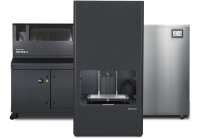
The university introduced Markforged Metal X and Mark Two systems to provide researchers with access to industrial additive manufacturing for both metal and composite applications. The technology now supports projects across a range of research areas, including additive manufacturing, polymer processing, biomanufacturing and advanced materials.
One of the group’s research programmes focused on developing complex copper EDM electrodes using Metal FFF technology. The project demonstrated how additive manufacturing could produce functional electrodes with material removal rates comparable to conventionally manufactured alternatives while enabling geometries that would be difficult or uneconomical to produce using traditional manufacturing techniques.
Alongside metal applications, the university also uses composite additive manufacturing for functional prototypes, tooling and research projects requiring lightweight, high-strength components.
The Results
By bringing industrial additive manufacturing in-house, the university has expanded its research capability while reducing dependence on outsourced manufacturing.
Researchers can now:
- Develop and evaluate complex manufacturing concepts more rapidly.
- Produce bespoke research tooling and functional components on demand.
- Support publicly funded and industrial research projects.
- Explore new manufacturing processes and engineering materials.
- Strengthen collaboration with commercial partners across multiple industries.
The flexibility of the Markforged platform has also enabled the technology to be adopted by other research groups within the university, extending its value beyond a single department


Supporting Engineering Research Through Innovation
For universities, the value of industrial additive manufacturing extends far beyond producing prototypes.
The University of Las Palmas de Gran Canaria demonstrates how engineering departments can use additive manufacturing to accelerate research, support collaborative innovation and investigate advanced manufacturing processes that would be difficult to achieve using conventional methods alone.
By combining traditional manufacturing with industrial 3D printing, researchers have greater freedom to develop, test and refine new ideas while preparing students for the manufacturing technologies increasingly used throughout industry.

At a glance:
Ready to Accelerate Engineering Research?
Whether you’re looking to enhance engineering education, support research programmes or strengthen collaboration with industry, Mark3D can help you introduce industrial additive manufacturing into your department.
Get in touch with us at Mark3D UK Limited to arrange a live demonstration at your facility, or to request a sample 3D printed part to test yourself!
Looking to introduce industrial 3D printing into your engineering department?
Explore our 3D Printing for Education hub to discover how universities are preparing students, accelerating research and strengthening industry collaboration.

Learn more about 3D printing continuous fibres!
Which continuous fibre is suitable for which applications? How do I design correctly for filament 3D printing? What do users say and where can I find more information? – This is the right place for you! The guides below can tell you everything you need to know.

ISS Aerospace Case Study
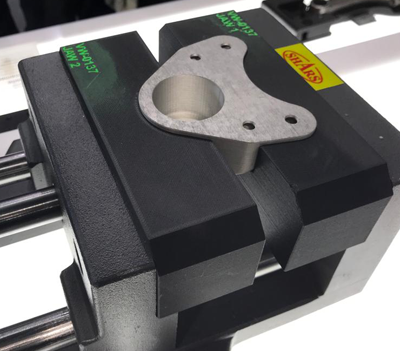
See how ISS Aerospace make weight and cost savings by 3D printing their UAVs with Markforged.
3D Printing in Production
This free guide serves as a source of information for engineers and contractors who want to integrate a 3D printer into their manufacturing process.
Primetall Case Study
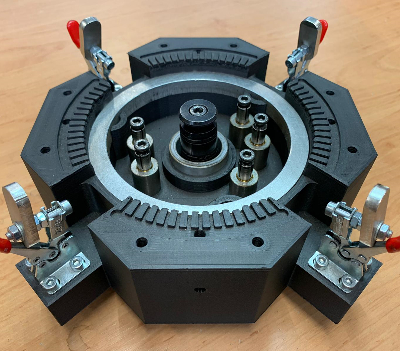
In this practical case study from Primetall, 3D printing was used to print custom fixtures. It was practically “drilled around the corner”.
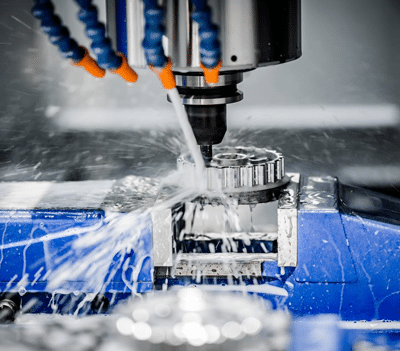
3D Printing vs. CNC Machining
The two production technologies each have various benefits and drawbacks, and this article identifys the applications which best benefit from one or the other.